



Blog
Manjushri Bodhisattva

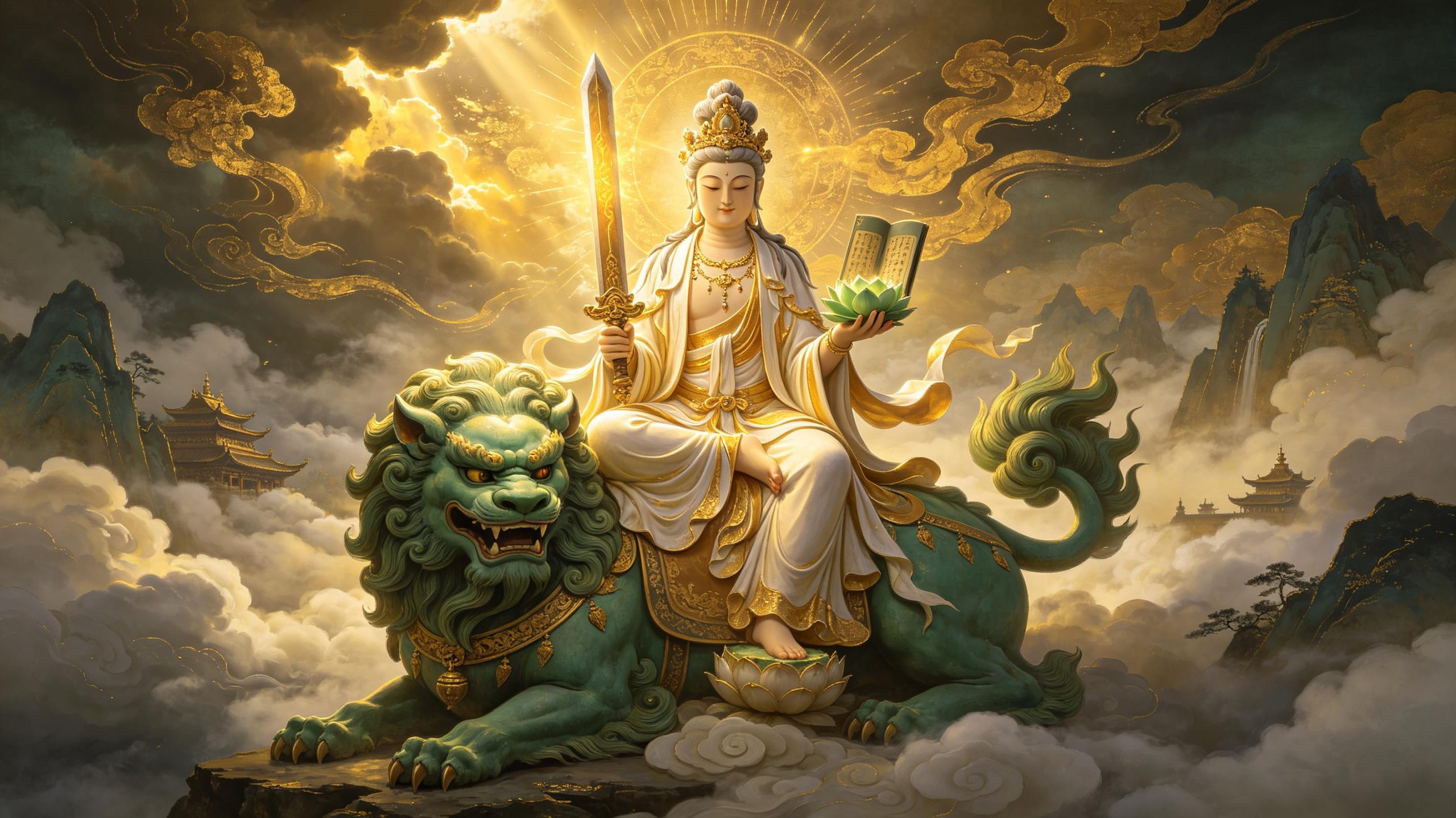
Manjushri (Wenshushili in Chinese) is a transliteration from Sanskrit that translates to “Wondrous Virtue” or “Wondrous Auspiciousness.” As one of the Four Great Bodhisattvas of Buddhism, he is renowned for his supreme wisdom and stands at the head of all Bodhisattvas. His presence spans vast reaches of time and space—from India to China, and from the Western Heavens to Mount Wutai. He is both the embodiment of wisdom and the realizer of Prajna (emptiness). Where his sword points, all afflictions are severed; where his lion roars, all demons are subdued.
Master of the Seven Buddhas
Manjushri is by no means an ordinary Bodhisattva. According to Buddhist scriptures, he attained Buddhahood in the distant past—manifesting as the Tathagata Dragon-Seed Supreme King in the Shurangama Samadhi Sutra and as the Tathagata Great Body in the Jeweled Necklace Sutra. His appearance as a Bodhisattva is a purposeful manifestation to assist Shakyamuni Buddha in teaching sentience beings.
Even more extraordinary, Manjushri is revered as the “Teacher of the Seven Buddhas” and the “Mother of All Buddhas.” The Lotus Sutra records that in a past age, Bodhisattva Sun-Moon-Light had a disciple named Bodhisattva Wondrous Light (a prior birth of Manjushri), who guided eight princes to Buddhahood sequentially. The last of these princes was Dipankara Buddha, who later became the teacher of Shakyamuni Buddha. In other words, the ultimate source of Shakyamuni’s enlightenment traces back to Manjushri. The Buddha himself declared:
“That I have attained Buddhahood today is all due to the grace of Manjushri. Countless Buddhas of the past were all disciples of Manjushri, and those of the future will also owe their realization to his divine power.”
Such supreme honor is uniquely held by Manjushri among all Bodhisattvas.
Dharma Prince and the Sword of Wisdom
In the assemblies of Shakyamuni Buddha, Manjushri holds the honored position of “Dharma Prince” leading the Bodhisattvas. Throughout the Buddha’s 49 years of teaching and over 300 Mahayana assemblies, Manjushri was almost always present. His wisdom lay not only in vast knowledge, but also in deep insight and sharp, incisive sharpness of mind.
- The Vimalakirti Sutra: When the lay devotee Vimalakirti feigned illness, the Buddha asked his great disciples to visit him. The Arhats all declined, feeling unworthy. Only Manjushri stepped forward without hesitation, leading the crowd to engage in a profound debate on the “Dharma Door of Non-Duality,” inspiring divine flowers to rain down in celebration of their wisdom.
- The Shurangama Sutra: When Ananda was entranced by the spell of Matangi, Manjushri bore the sacred mantra to rescue him, breaking through delusion with a single stroke to protect the path of future practitioners.
- The Lotus Sutra: When the Buddha emitted a ray of light from his brow, leaving the assembly bewildered, it was Manjushri who understood the Buddha’s intent and requested him to preach the Great Dharma, laying the foundational philosophy of Mahayana Buddhism.
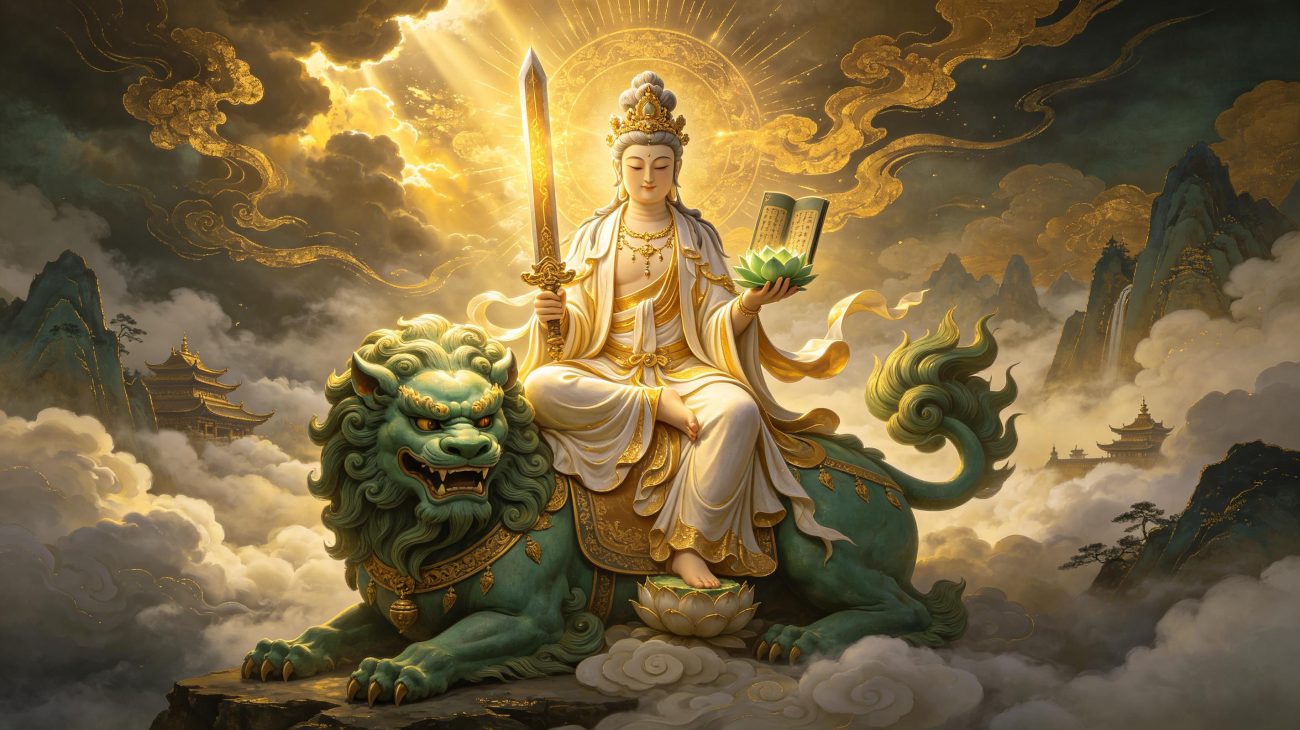
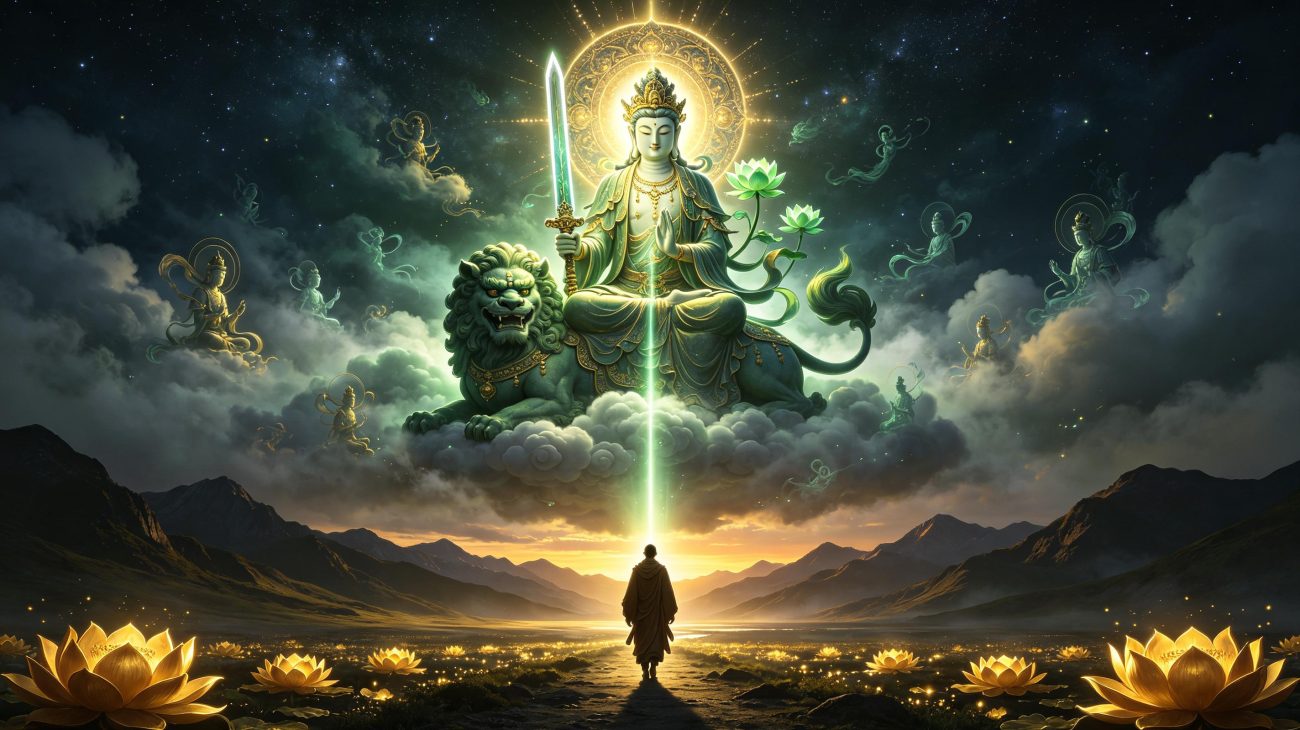
The iconography of Manjushri is rich and deeply symbolic:
- Five Topknots: Represent the Five Wisdoms of the Buddha.
- Vajra Sword (Right Hand): Symbolizes wisdom capable of severing all worldly afflictions.
- Blue Lotus holding the Prajnaparamita Sutra (Left Hand): Represents the pure, untainted teachings of ultimate wisdom.
- Blue Lion (Mount): Symbolizes the fierce power of wisdom to tame all inner passions and illusions.
Every aspect of his solemn form reflects the profound depth and power of Great Wisdom.
Mount Wutai and the Qingliang Stone
The Avatamsaka Sutra (Bodhisattva Dwellings Chapter) states:
“In the northeast, there is a place called the Cool (Qingliang) Mountain, where Bodhisattvas have dwelt since ancient times. Currently, a Bodhisattva named Manjushri resides there with his retinue of 10,000 Bodhisattvas, constantly expounding the Dharma.”
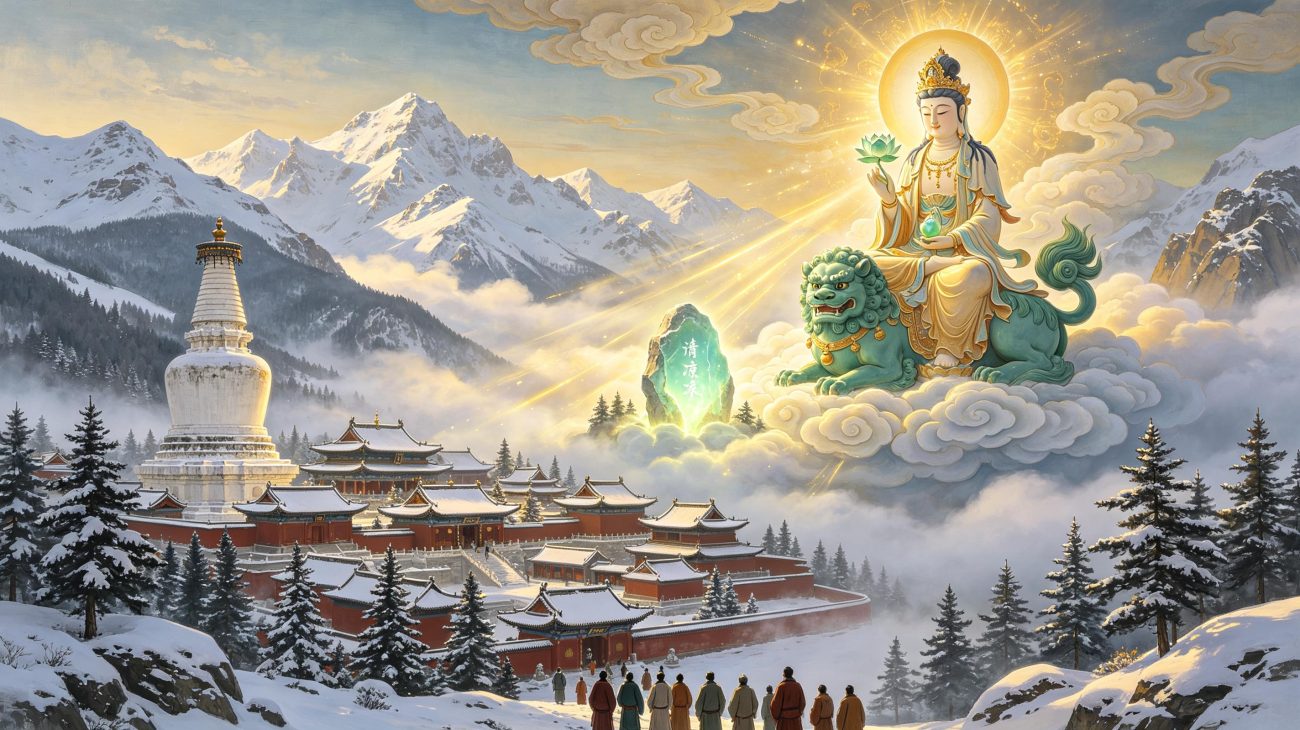
Mount Wutai in Shanxi, China—known for its snow-capped peaks and cool summers—became honored as the sacred Bodhimanda (seat of enlightenment) of Manjushri Bodhisattva.
A popular legend surrounds Mount Wutai: In ancient times, the region suffered from unbearable heat, causing immense hardship for the local people. Moved by compassion, Manjushri traveled to the Dragon Palace to borrow the “Qingliang (Cooling) Stone” and placed it in the mountains. From then on, Mount Wutai transformed into a refreshing sanctuary with abundant harvests. The five sons of the Dragon King tried to reclaim the treasure in anger, but Manjushri subdued them; they became guardian deities, now enshrined in the famous Wuye Temple on Mount Wutai. This Cooling Stone represents not just a change in climate, but the power of wisdom to extinguish the burning fevers of the human mind.
Compassionate Manifestation: The Poor Woman’s Feasts
Manjushri’s compassion is boundless, and he frequently appears in various disguises to guide sentient beings. Among these accounts, the story of “The Poor Woman Begging for Food” is the most renowned.
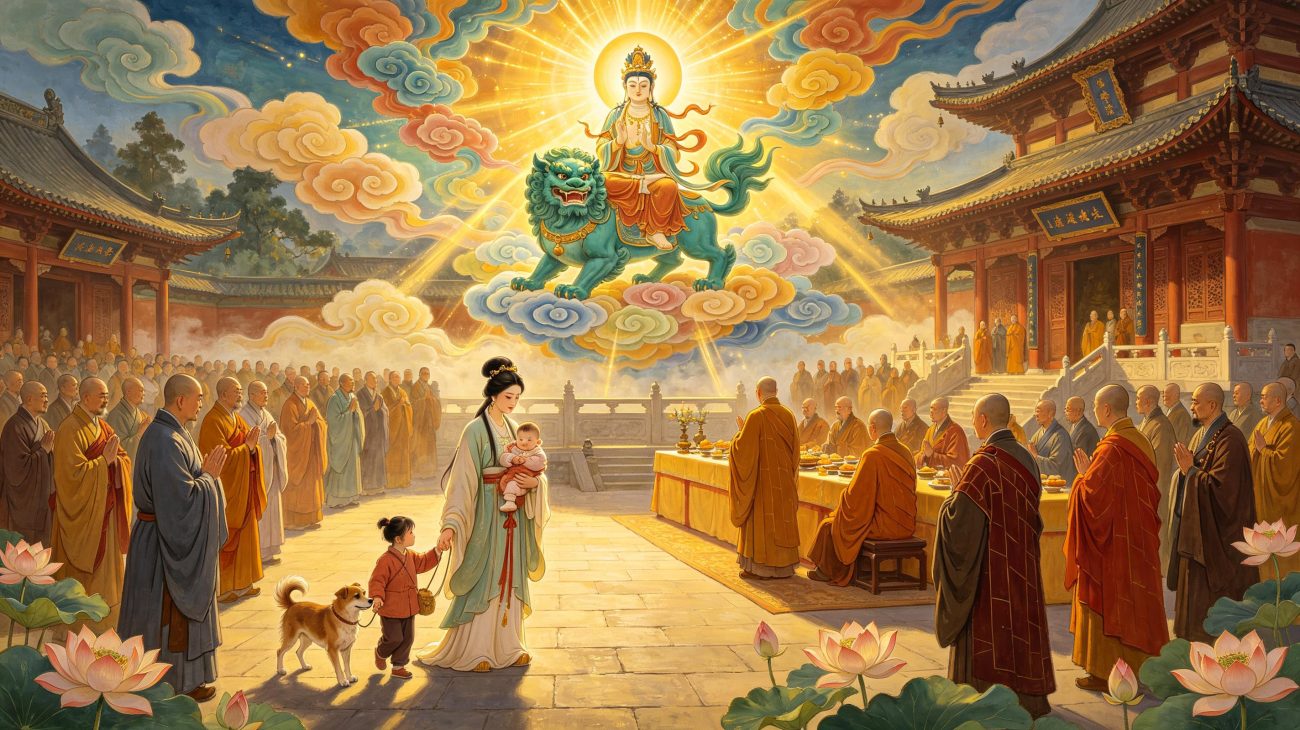
During a grand vegetarian feast hosted at a monastery, a poor woman arrived carrying a baby, leading a young child, and accompanied by a dog. Possessing no money, she cut off her hair as an offering. As the meal began, she urged the abbot to let her eat first because she had an urgent journey ahead. The abbot gave her three portions of food for herself and her children. However, the woman requested: “I also have a dog; please give it a portion as well.” The abbot reluctantly obliged. She then added: “I carry an unborn child in my womb; it needs a portion too.”
Unable to contain his annoyance, the abbot scolded her sharply: “You ask time and time again out of insatiable greed! The child in your womb isn’t even born yet—how can it eat?” He then ordered her to leave.
Upon being scolded, the poor woman rose into the air and revealed her true form as Manjushri Bodhisattva. The dog transformed into the Blue Lion, and the two children became Sudhana (the Good Wealth Youth) and the Attendant Prince of Khotan, surrounded by five-colored radiant clouds. Manjushri recited a verse:
A bitter gourd is bitter to its root,
A sweet melon is sweet to its stem.
It is I who transcend the Three Realms,
Yet I am disdained by this Venerable Master.
Filled with deep remorse, the abbot realized that the Bodhisattva had come in disguise to test their equality of mind, and that he had failed by judging with a discriminatory heart. In his grief, he wished to gouge out his own eyes, but was persuaded against it by the assembly. Later, a pagoda was erected to house the hair offered by the poor woman, and from that day on, the abbot treated all people—rich or poor, high or low—with complete equality.
This story serves as a wake-up call: The primary meaning of wisdom is equal treatment of all beings and the removal of discrimination.
The Contemporary Significance of Wisdom
Manjushri’s wisdom is not an abstract concept floating in the clouds; it is deeply rooted in daily life. Ultimate wisdom (Prajna) is formless and intangible, often described in scriptures as “beyond the reach of words and mental concepts.” Manjushri manifests in physical form precisely so that ordinary people can grasp the vital importance of wisdom in spiritual practice.
Buddhism often teaches that “Compassion is the root, and skillful means are the door.” Yet without wisdom as a guide, compassion and skillful means can devolve into blind sentimentality or misguided indulgence. Manjushri’s wisdom teaches us to maintain clarity and reason in life, untangled by emotional confusion; to treat all beings with an equal mind free of discrimination; and to skillfully apply our minds to shatter all attachments.
As the Avatamsaka Sutra notes:
“If Bodhisattvas make good use of their minds, they will attain all supreme and wondrous merits.”
Spiritual cultivation is the cultivation of the mind—removing illusions to reveal one’s true nature. Manjushri’s wisdom is not a passive escape from the world, but an active benefit to others. Just like the sword of wisdom he holds, what it cuts through is not external objects, but the subtle veil of “discrimination” within our hearts. Once that veil is severed, Prajna wisdom is revealed everywhere.
Conclusion
For over two thousand years, the image of Manjushri Bodhisattva—holding a treasure sword and seated upon a lotus throne—has inspired and comforted countless minds. Whether one practices Buddhism or not, encountering this Bodhisattva evokes a sense of clarity, sharpness, and profound compassion. He serves as a gentle reminder: Wisdom is neither distant nor unreachable; it resides in every present moment. The moment we choose to lay down our discriminatory minds, the sword of wisdom hanging above us illuminates the path for every traveler walking through the dark.