



Blog
Entering the Zen Realm, I Met the Buddha

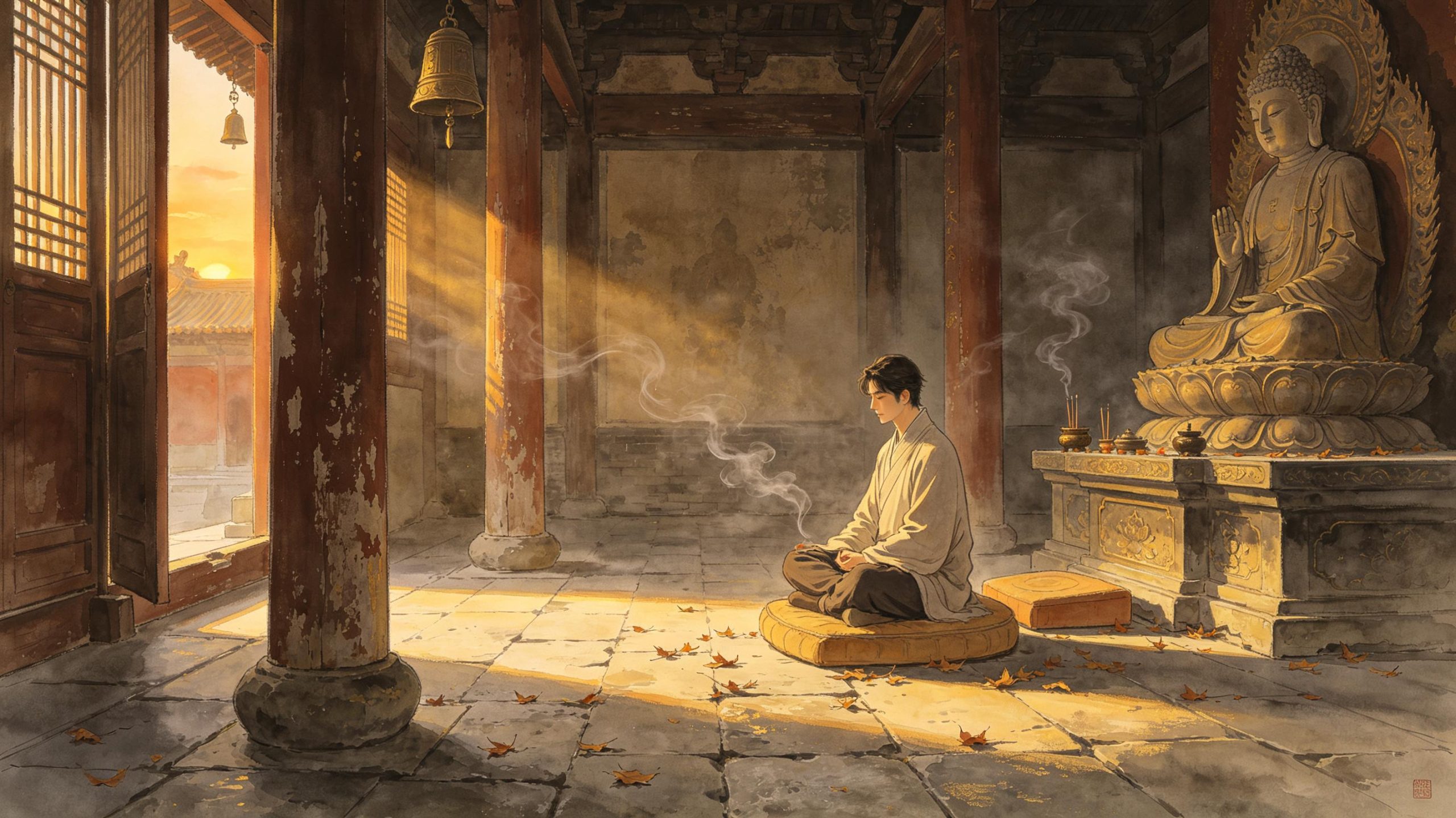
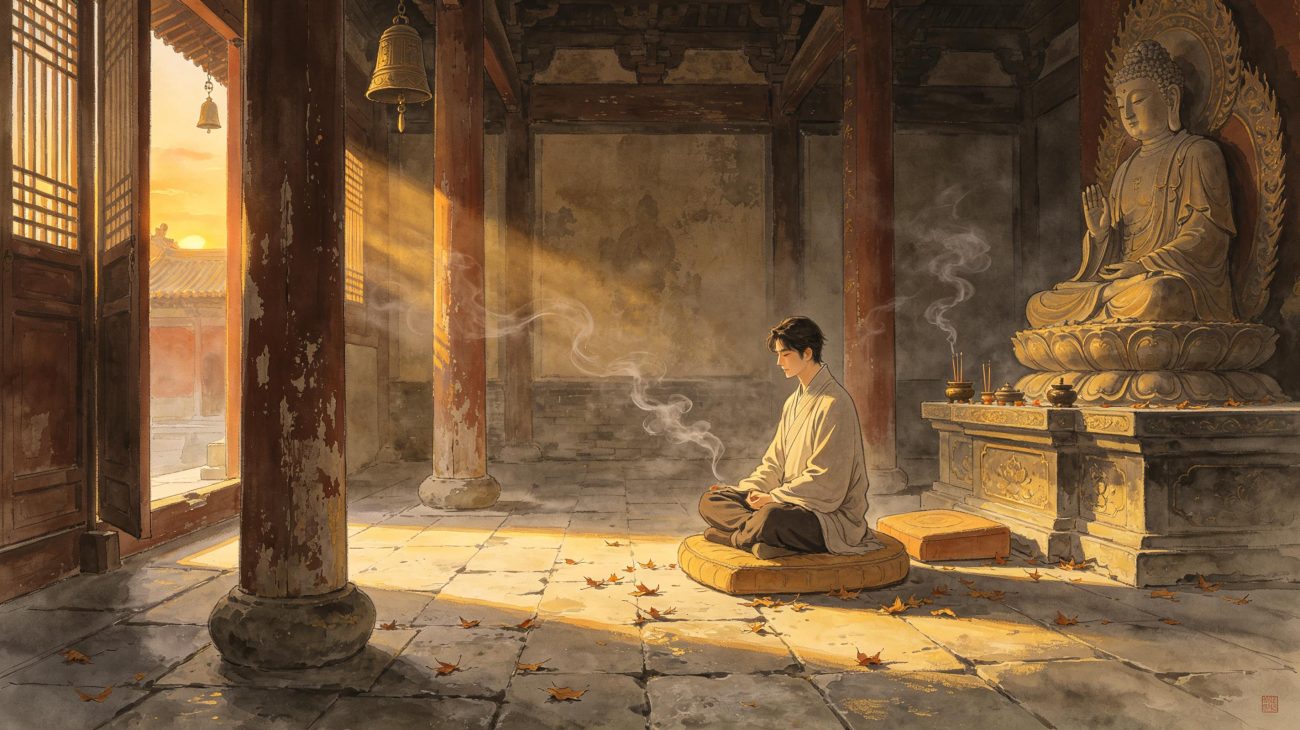
The scent of incense had weakened. First, the heavy, sweet scent of sandalwood—the kind that clings to one’s collar for three days—faded away. Then went the faint blue smoke, and finally, even the warm, stifling odor of the mortal world brought by the pilgrims dissipated completely. At my nose remained only the smell of old wood and dust, along with an indescribable crispness rising from the depths of the meditation room, like stones soaked in snowmelt.
The clamor around my ears peeled away layer by layer: the tour guide’s megaphone, a child’s crying, the giggles of lovers, the incessant thud of footsteps—all receded like an ebbing tide. At last, nothing was left but the sound of the wind passing through the iron wind-bells hanging from the eaves: Cling—cling—, one chime, then another, separated by long spans of silence.
I had been sitting on the cushion for a long time. It began with the sour numbness of crossed legs, like a thousand fine needles pricking at once. Later, the numbness melted; my legs no longer felt like my own, turning into two unfeeling logs that nevertheless held my torso firm and steady. My eyelids drooped naturally, though it was not entirely pitch-black before my eyes. There was a hazy, dark-red glow—the color of blood flowing through vessels, pulsing rhythmically like distant tides. My breathing slowed, akin to drawing water from a deep well: one bucket, a pause, then another bucket.
Yet my thoughts refused to settle. They rose and fell like mud and sand stirred from the bottom of a pond—turbid, murky, swirling up before sinking back down. I thought of the half-drunk cup of tea from this morning, wondering if the leaves had settled to the bottom; I wondered if my return ticket was still tucked safely in the inner pocket of my wallet; I recalled a spring afternoon many years ago, and how willow catkins drifted through the classroom window. These thoughts came as they pleased. I neither chased nor dismissed them, merely watching as they gathered and dispersed like clouds. Gradually, the clouds thinned and scattered, revealing the clear, bright void beneath.
In that very void, a speck of light suddenly appeared.
At first, the light was extremely faint—like the first trembling, hesitant ray of a winter dawn. It seeped out from nothingness, silent as water oozing from a fissure in a rock. I did not open my eyes, yet I “saw” it. The phrasing itself is a paradox, but that was precisely how it felt. The light grew steadily brighter into a non-glaring, gentle radiance, reminiscent of a pearl bathed in moonlight. Simultaneously, a strange quietude descended. Even the earlier cling—cling of the wind-bells ceased; even my own breathing seemed to halt. Between heaven and earth, only this light and this silence remained.
Then, the light condensed. At its center, an outline emerged. At first, it was merely a blur of warmth, like white mist breathed onto a windowpane in winter; gradually, it clarified, taking on shape and form. I saw a figure seated deep within the light, draped in a kasaya—the red of the robe was that of ancient cinnabar, settled and bled out over time, deep, warm, possessing the earthy richness and soft texture of flower petals. He sat in the lotus position, hands joined in the dhyana mudra. His face… I found myself momentarily at a loss to describe it. I tried to look at his features: his eyes were half-closed, mercy flowing from their slits like honey. A faint, almost imperceptible smile rested at the corners of his mouth—not a smile of the mortal world, but the smile of one who, having seen through three thousand kalpas of suffering, still finds that all is well. Yet strangely, whenever I attempted to commit the details of his face to memory, it blurred; when I abandoned the attempt to look, it reappeared clearly—round as a full moon, serene as autumn waters.
Is this the Buddha? The thought floated up in my mind, casting ripples across a quiet lake. The figure in the light shifted ever so slightly—or perhaps it was my imagination—and then I heard a voice. The sound did not seem to enter through my ears; rather, it echoed directly within my heart, like the very first sound of a seed splitting open in the earth:
“You have come.”
The voice was exceedingly gentle, yet possessed an indisputable resonance. I intended to answer, but when I opened my mouth, no sound came out. Surrounded by this radiance and quietude, words felt superfluous and clumsy. And so, within my heart, I replied: “Yes, I have come.”
“It has been a long, weary journey,” the voice said again. Just then, I felt a peculiar warmth rise from the soles of my feet, like warm water slowly welling up past my ankles, knees, and waist. As it reached my chest, many hardened things dissolved. The grievances I thought I had long forgotten, the fatigue accumulated in the marrow of my bones over years, the indefinable loneliness—all dissolved within this warmth, turning into tears. Tears fell silently into the corners of my mouth—salty and warm.
The Buddha in the light—for so I shall call him—did not stop these tears. He merely watched quietly, his gaze carrying the warmth of spring sun and the vastness of an autumn sky. I wept for a long time, until the ice at the bottom of my heart had completely thawed, before I slowly stopped. A lightness I had never known swept over me, as though a heavy burden carried for years had finally been put down. My body felt so light it might float away.
“Sit closer,” he said. I discovered I could indeed move—not by walking with my feet, but through a much subtler shift. In an instant, I was before him, close enough to discern the weave of his robe: the threads crossed in warp and weft, each strand shimmering with fine bits of light, as if the Milky Way had fallen onto the fabric.
He raised his hand. That hand, too, was condensed light, its knuckles distinct and fingertips rounded. He pointed to my chest: “Here… does it still hurt?”
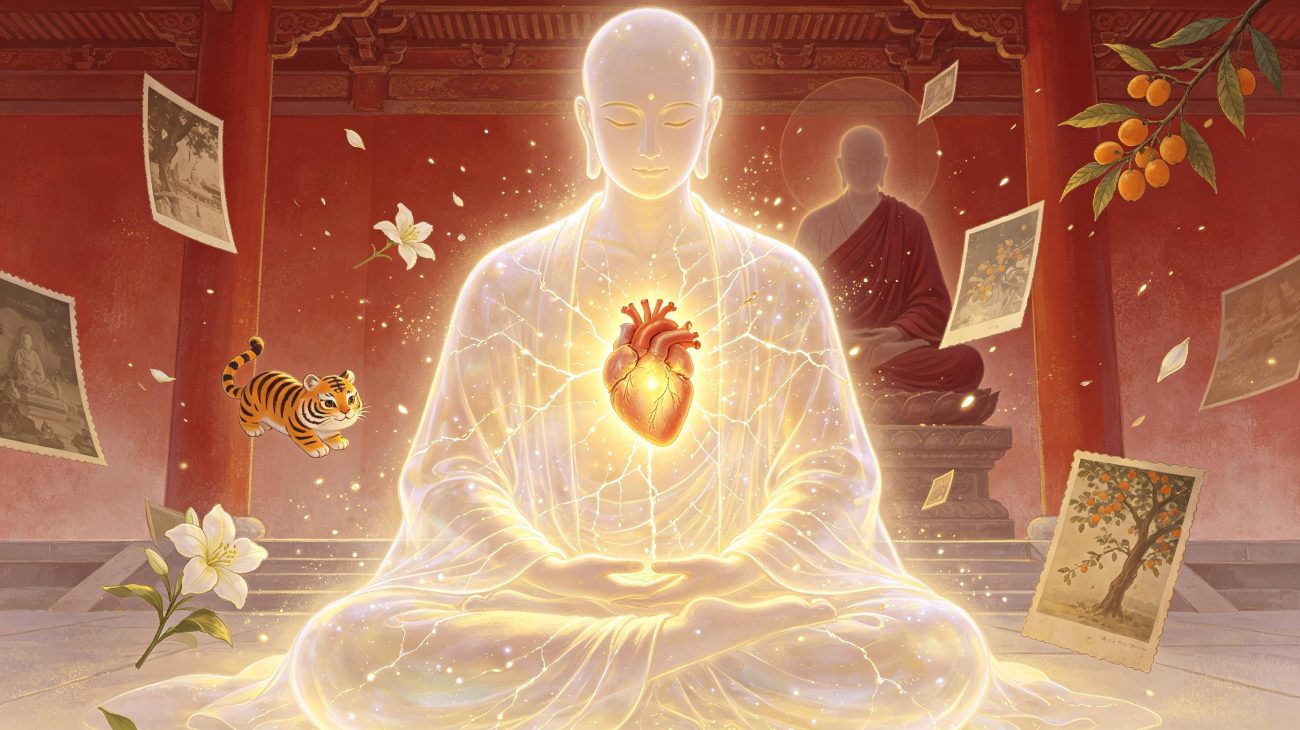
I looked down. Unbeknownst to me, my chest had turned transparent. My heart beat within that clarity, bright red like a fully ripened fruit. Oddly, the heart was covered in fine, dense cracks; some were deep enough to expose bone, while others were healing, forming pale pink scabs. With every beat, tiny specks of light drifted from the fissures, falling into the void like fireflies.
“It hurts,” I answered truthfully.
“Pain is good,” he said. “An unpained heart is made of stone. This heart of yours—it still hurts, it still bleeds, and it still heals. It is alive.”
He extended a single finger and touched my heart lightly. The tip of his finger was cool as jade. The moment it touched me, a tremor ran through my entire body, and countless scenes surged from the depths of my heart—not mere memories, but things more authentic than memory itself:
I saw the cloth tiger I lost at three years old; it had never truly been lost, but had turned into a cloud, still drifting in the sky to this day. I saw the girl I loved at eighteen; the scent of gardenias in her hair had never scattered, but had woven into every gust of wind from that summer. I saw my late grandmother; she had never truly left, but had transformed into the loquat tree in the courtyard, bearing golden fruit year after year… None of these images were deliberately recalled; they spilled from the cracks of my heart, carrying light and warmth, like spring water gushing from stone fissures.
“Do you see?” The Buddha’s voice held a touch of a smile. “You carry the entire universe in your heart. Every crack is a place where the light enters.”
I felt the cool touch seep into every fracture of my heart. The cracks began to mend slowly in the light—not disappearing, but becoming more transparent, softer. The rhythm of my heartbeat changed; the original dull thump-thump grew clear and bright, like the sound of a mountain stream striking rock.
“But,” I spoke, my voice actually sounding aloud this time, “people outside say that the Buddha is emptiness. Form is emptiness, emptiness is form. Why is it that the Buddha I see feels so… real?”
The Buddha smiled. As he did, the entire realm of light rippled, as if a stone had been tossed into a serene lake.
“Emptiness is the mother of all things,” he said. “Look at this light, look at these shadows, look at the red of this robe—they all arise from emptiness. Emptiness is not nothingness; emptiness is infinite possibility. You see me because your heart has taken shape; your heart has taken shape because you have experienced those pains, those loves, those losses. None of these are obstacles; they are steps on a staircase.”
He pointed again to my heart, which had now turned translucent, a soft golden light seeping through the mended cracks.
“You thought you came to see me. In truth, it was I who came to see you. Every person who seeks the Way with a sincere heart is an incarnation of the Buddha. Look at the statues in this hall—they were sculpted by devotees out of wood, mud, gold, and silver. But the Buddha in your heart was sculpted out of your blood, your tears, and your breath. It is more real than any golden statue.”
I suddenly remembered the temple where I was sitting. I remembered the elderly women kneeling before the Buddha, murmuring prayers for their distant children’s safety; I remembered the middle-aged man in a business suit, a flicker of anxiety in his eyes as he dropped large bills into the donation box; I remembered the teenage girl in a school uniform, her face flushing red before the statue of the Matchmaker God… What they sought were all affairs of the mortal world: safety, wealth, romance. How did the Buddha—if the one before me was real—respond to these chaotic supplications?
“I hear what you are asking in your heart,” he said. “Those prayers—I hear them all. But I never grant them directly. I give them something else instead: to the old woman, a sense of inner peace, letting her believe as she kneels that there is something greater in the universe than her worries; to the businessman, a fleeting moment of stillness, letting him temporarily forget the numbers on his ledger the moment he donates his money; to the young girl, a sweet flutter of the heart, giving her faith that love is worth expecting. None of these are what they asked for, yet they are precisely what they truly need.”
“So you are not miraculous?” I asked. The moment the words left my mouth, I regretted them, feeling I had been disrespectful.
The Buddha took no offense; instead, his smile broadened even further. “What does it mean to be miraculous? To ask for rain and receive rain, to ask for a child and receive a child? How would such a Buddha differ from a local earth deity, a fox spirit, or any granting ghost or god? A Buddha ought not to do business. A Buddha is meant to do something else—”
He paused, pointing outside the hall. Following his gaze, I “saw” the mountain gate of the temple. Outside the gate lay the stone steps leading down the mountain, and at the end of the steps was the mortal world. Many people walked upon those steps: those ascending carried expectation on their faces, while those descending bore faces of satisfaction or disappointment.
“Do you see those stone steps? Every single step is an act of letting go. Letting go of a little attachment, a little greed, a little resentment. Those who reach the summit may not necessarily find what they sought, but they have put down things they did not need. That is the true meaning of paying homage to the Buddha.”
“Then,” I pressed further, “what if one asks for nothing, does not even bow, but simply sits in silence?”
“That is the best of all,” the Buddha said, a trace of comfort in his voice. “You came to see me not because you wanted to ask me for something, but because you could no longer sit still. The doubts in your heart burned like fire; those pains could be told to no one, those confusions had nowhere to be resolved. You came here, sat down, breathed, and waited. That is enough. You need not speak your prayer; I have known it all along. Look—”
He pointed once more to my chest. Looking down, I saw a particularly deep crack among the fractures on my heart, looking as if it had been cut by a sharp blade. Within it was a figure—a younger version of myself, standing at a crossroads, facing two diverging paths. That younger self looked utterly bewildered, not knowing whether to turn left or right. I suddenly recognized it as the year I graduated from college, when I turned down the job my parents had arranged and insisted on going far away. How much wandering and hardship that single choice had brought, how many late-night doubts it had sparked. I had always believed it to be the greatest mistake of my life.
“You see it now,” the Buddha said. “You carved that wound yourself. But look closely now—”
I focused my eyes. Deep within the crack, the distant views of both paths were revealed: one was smooth and flat, leading to the security of a small town, with a nine-to-five routine, pleasantries exchanged among neighbors, and a life lived by the book. The other was rugged and steep, leading to an unknown distance, filled with drifting, disappointment, as well as this very day where I sat before the Buddha. Yet in the distance, the two paths actually merged, flowing into the same river and emptying into the same sea.
“There are no wrong paths,” the Buddha said. “There are only the path you chose and the path you did not. The path you chose made you who you are today; the path you did not choose made another version of you. Both versions of you are good; both are complete. That crack in your heart is actually a door leading to the life you never lived. You look through this door and see another possibility, and so you assume you missed out on something. But you do not know that the version of you living peacefully in that small town might be sitting in a local shrine at this very moment, looking through another door, envying the version of you who went far away.”
These words struck like lightning, shattering a block of hard ice in my heart. The regret that had weighed on my chest for years suddenly loosened, turning into a warm liquid that coursed through my veins. I let out a long, deep breath; the breath condensed into white mist before dissolving into the light.
“But,” I asked again, “there is so much suffering in this world. The hungry, the sick, the oppressed, the brokenhearted. If the Buddha is truly compassionate, why not reach out a hand?”
Asking this felt heavy even to me. For the first time, a shift passed over the Buddha’s face; his smile took on a poignant mercy I could not fully comprehend. He did not answer right away, but simply held out his hand, opening his palm.
I saw the lines on his palm crisscrossing—every line was a river, and within every river flowed the destinies of human beings. There were children weeping in the fires of war, mothers shedding tears by sickbeds, lovers parting in the rain, elderly people sitting alone late at night. Those images packed his palm tightly, forming a vast, boundless net.
“Look at the sentient beings in this palm,” he said. “I reach out my hand every single moment. But when I extend my hand, it is not to take away their suffering. If I did that, they would remain children forever, never learning how to walk. My hand reaches out to catch them, so that when they fall, they do not shatter to pieces. Suffering is a river; I am the bridge. You cannot demand that the bridge flatten the river, but you can walk across the bridge to the other shore. The other shore may not be free of suffering, but you will have gained a pair of feet that know how to cross a bridge.”
His palm closed, and the images vanished, leaving only the warmth of his hand.
“You sit here now, your breathing smooth, your heart at peace. You think you found me, but in truth, it was I who found you. Every scar in your heart was a signpost I left for you. You followed the pain all the way here, only to discover that at the end of pain lies light. That is all there is to it.”
Suddenly, a wave of drowsiness washed over me. It was not physical exhaustion, but a deeper kind of sleepiness—as if a traveler after a long, arduous journey had finally arrived home, free to lay down everything and close his eyes in peace.
The face of the Buddha in the light slowly blurred, and his voice drifted further and further away, like an echo from a deep valley:
“Go now. You have seen it. When you return, when you drink tea, let the tea be tea; when you eat, let the rice be rice; when you walk, let the road be the road. You will see mountains as mountains, and waters as waters—only, there will be a lamp lit in your heart. That lamp is me, and it is also you.”
Desperate to keep him, I reached out to grasp his robe. Yet my fingertips touched only a cool breeze, along with an aroma drifting in the wind that I could not identify as sandalwood or blossoms.
I snapped my eyes open.
The hall was still the same hall. Slanted rays of the setting sun poured through the western window, casting a warm, golden glow on the stone floor before the altar. I looked down at myself: my legs were intensely numb from sitting cross-legged, my knees stiff, my back aching. A small withered leaf lay beside my cushion, though I knew not when or from where it had drifted in. The iron wind-bells at the corner of the hall were still chiming in the breeze: Cling—cling—, one chime, then another.
I tried to move my stiff legs, and a needle-like numbness shot up from the soles of my feet, making me gasp. I pressed my hands against the floor, feeling the chill of the stone slabs. Raising my head, I looked up at the statue of the Buddha in the hall. It remained the same statue—a gold-gilded clay figure, eyes lowered in a gentle smile, no different from tens of thousands of Buddha statues in temples across the world. His face was serene, the faint smile at the corners of his mouth like moonlight reflected on deep water.
Was everything just now a hallucination? Was it a play of consciousness in the depths of meditation? I could not be sure. But there was indeed a peculiar feeling in my chest—warm and soft, as though something had just taken root and sprouted there. I unbuttoned my collar and looked down; the skin on my chest was smooth as usual, without cracks or golden light. Yet I felt distinctly that a lamp had been placed there.
Pilgrims began filing in again; several young people raised their phones to take pictures, the flash blinding. The tour guide’s small flag waved at the entrance, and the loudspeaker blared a hurried call to gather. I stood up, my legs still a bit weak, and walked slowly out of the hall while holding onto a pillar. The mountain wind blew against my face, carrying the scent of pine needles and the smoky warmth of the distant town.
I looked back at the hall one last time. The Buddha sat there amidst the swirling incense, his face filled with compassion, just as he had always been.
The stone steps down the mountain stretched out beneath my feet, one by one. I walked very slowly. With every step, I felt the lamp in my chest sway gently to my pace—like a masthead lantern on a night-sailing ship, holding onto its small, warm point of light amid the wind and waves.
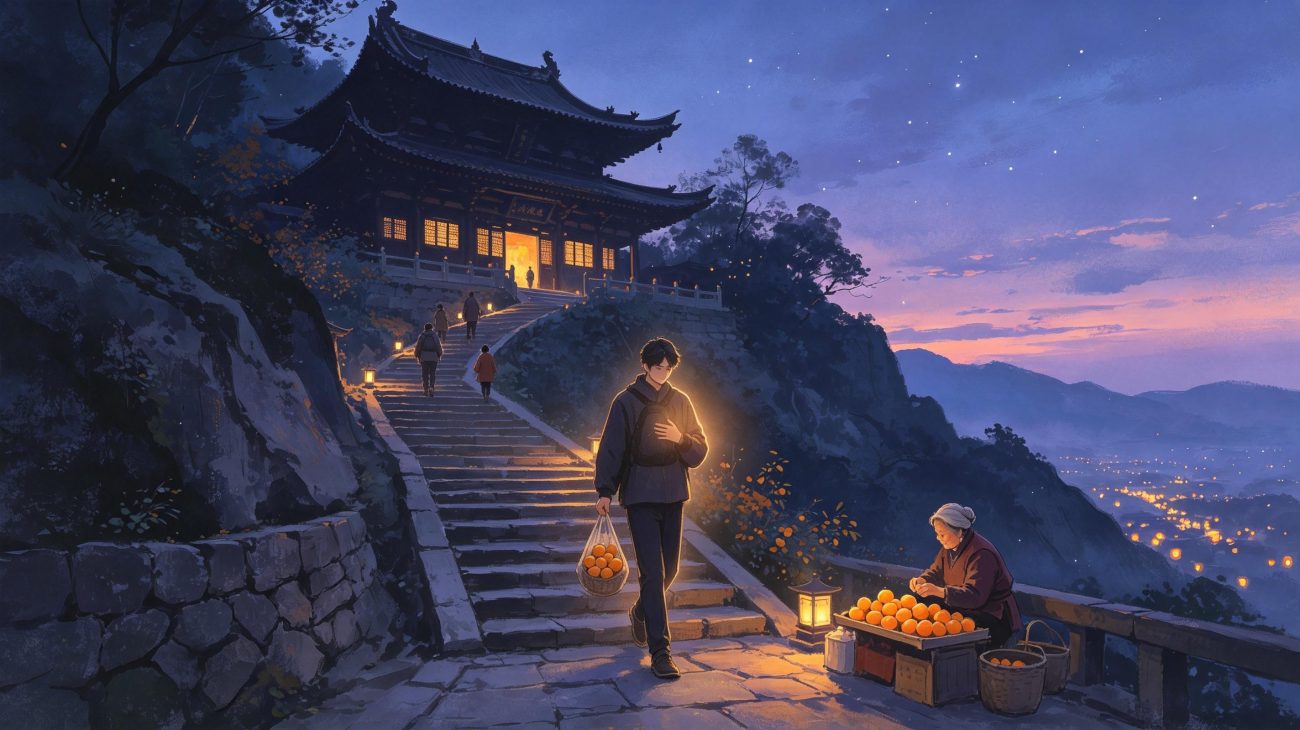
Halfway down the mountain, I paused and looked back. The flying eaves of the temple were reduced to a mere silhouette in the twilight; the lights inside the hall had been turned on—a hazy, warm yellow. A few late-returning pilgrims were picking their way up the steps, their backs gradually shrinking in the dusk. I remembered the scenes in the palm of the Buddha—the people weeping, loving and parting, struggling through hardship. He had said he was the bridge, the hand holding people so they would not shatter to pieces.
I did not know if he truly existed. Or rather, after today, the word “existence” felt far too thin to me. Some truths do not reside in the eyes, ears, nose, tongue, body, or mind; some encounters do not belong to coordinates of time and space. But the warmth of the heart was real, the saltiness of tears was real, and the light penetrating through the cracks was real.
I continued walking down the mountain. By the roadside sat an old woman selling oranges, neatly stacked in golden, rounded mounds like tiny suns. I bought a few and peeled one. The fragrance of the orange peel burst forth instantly—crisp, with a slightly spicy sweetness. I broke off a segment and put it into my mouth; the juice exploded on the tip of my tongue, distinctly sweet and sour—a vivid flavor of being alive that almost brought tears to my eyes.
The sun had set completely, and the lights at the foot of the mountain lit up one by one, like the earth responding to the stars in the sky. Walking amid these mortal lights, my steps gradually grew lighter. The wind blew from behind me, as if someone had given me a gentle push, or perhaps had not.
I touched my chest. It was quiet there, and the lamp was still burning.