



Blog
Green Tara

Green Tara: The Mother of Hope Born from Tears of Compassion
In the vast pantheon of Tibetan Buddhism, Green Tara has become the most beloved female deity, revered for her unique compassionate vows and swift power of salvation. Far from an aloof or austere deity, she is a motherly figure who “hears the cries and saves the suffering”—rushing to the aid of sentient beings struggling in the ocean of samsara, just as a mother runs to her weeping child. This profound sense of maternal warmth has allowed devotion to Green Tara to transcend millennia, comforting countless hearts with her vibrant, emerald-green energy of life and hope.
Born from Tears: Origins and Vows
The origin of Green Tara is a story of ultimate compassion.
According to the Tara Ekavimśati (Records of the Origin of Tara), countless eons ago, the Bodhisattva Avalokiteshvara liberated innumerable beings. Yet, when he observed the six realms with his wisdom eye, he saw that the suffering of beings had not diminished. Overwhelmed by grief, tears flowed from his eyes. A tear fell and transformed into a lotus flower, from which Green Tara emerged, who then manifested as the Twenty-One Taras.
Upon their manifestation, these Taras made a solemn vow to Avalokiteshvara: “Do not grieve; I shall be your companion to fulfill the noble deed of liberating boundless sentient beings.” Thus, Green Tara assumed the mission of aiding Avalokiteshvara in saving all beings. Another legend tells that Avalokiteshvara’s right tear became Green Tara, while his left tear became White Tara, representing wisdom and compassion, respectively. Whichever the account, Green Tara’s essence is the direct manifestation of great compassion.
Notably, while practicing on the causal stage, Green Tara vowed to achieve enlightenment in a female form. When monks advised her to pray for rebirth as a male to attain buddhahood, she steadfastly refused: “Many practitioners before me have vowed to attain buddhahood and liberate beings in a male form, but I dedicate myself to achieving buddhahood and benefiting beings in a female body.” This resolve established her unique standing as a female savior.
The Emerald Form: Esoteric Meanings of Her Iconography
The iconography of Green Tara is like a visual poem, with every detail steeped in profound symbolism:
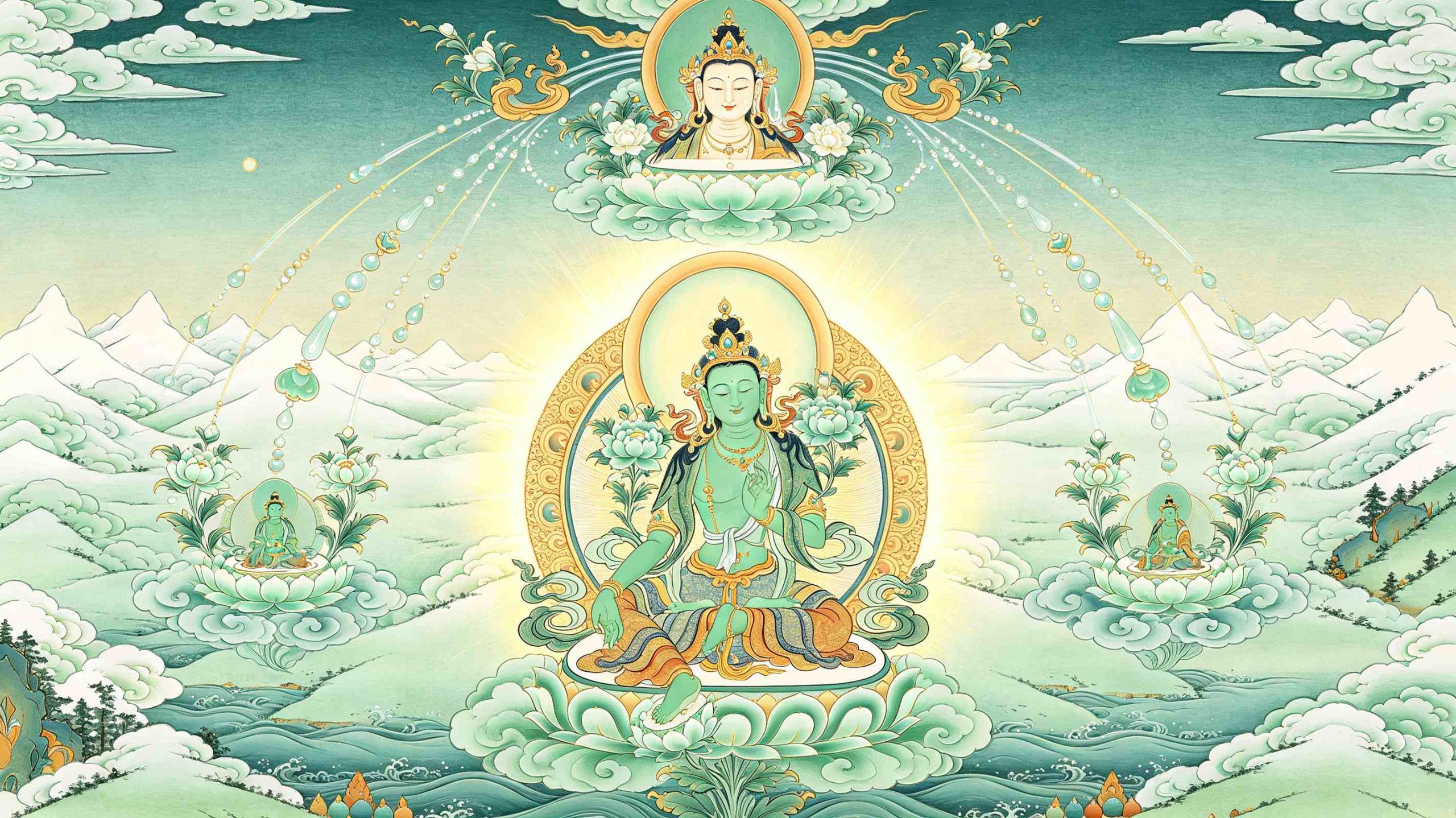
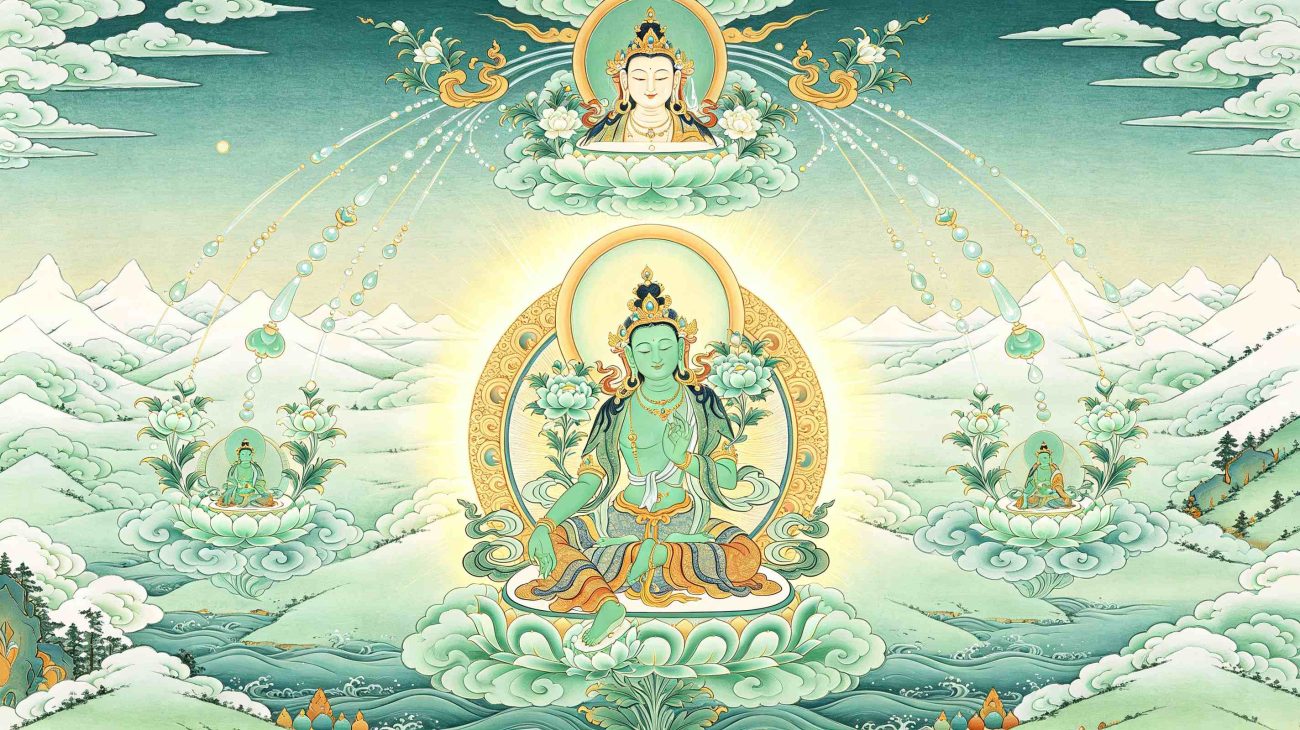
- Emerald-Green Body: Green is her most distinctive feature, representing life, hope, and vibrant, unceasing creativity, driving away all gloom and despair. In the Five Tathagatas framework, green belongs to Amoghasiddhi Buddha, symbolizing “All-Accomplishing Wisdom” (Krtyanusthana-jnana) and the enlightened activities of all Buddhas. This signifies her ability to accomplish all noble endeavors for the benefit of all beings.
- The Posture of Ease (Lalitasana): Her left leg is folded in meditation, while her right leg extends downward, resting on a lotus flower. This stance symbolizes her readiness to step forward instantly to rescue beings—like a loving mother who leaps to her feet the moment her child calls.
- Mudras (Hand Gestures): Her right hand rests on her right knee, palm facing outward in the Varada Mudra (boon-granting gesture), symbolizing the bestowment of fearlessness, compassion, and the fulfillment of wishes. Her left hand is held at her chest in the Three Jewels Mudra, with the thumb and ring finger touching, representing the union of compassion and wisdom.
- The Utpala Flowers: Green Tara holds a blue night-lotus (Utpala) in each hand, its stems blossoming near her shoulders. Each stem features three stages: a seedpod, a fully open bloom, and a closed bud. These represent the past Buddha (Kashyapa), the present Buddha (Shakyamuni), and the future Buddha (Maitreya). This detail signifies that Green Tara is the total embodiment and activity of all Buddhas across the three times.
Savior from the Eight Dreads and the Swift Heroine
In the Tibetan tradition, Green Tara is revered as the “Saver from the Eight Dreads,” capable of liberating beings from eight external perils: lions, elephants, fire, snakes, imprisonment, thieves, water, and demons.
These eight dreads also symbolize internal mental afflictions:
- Lions represent pride.
- Elephants represent ignorance.
- Fire represents anger.
- Snakes represent jealousy.
Her salvation extends beyond physical protection to the transformation of the inner mind. Notably, Green Tara transforms “doubt”—one of the five mental poisons—into perfect, ultimate wisdom. Doubt is one of the greatest obstacles on the spiritual path: doubting one’s ability to achieve realization or doubting the truth of the Dharma. Her blessings sever this self-doubt, fostering unshakeable faith in practitioners.
Because her swiftness and courage in saving beings are unmatched, she is also honored as the “Swift and Courageous Liberator” (Tāra Tūre). Tibetans hold a deep conviction that in degenerate times, when obstacles are numerous and practice is difficult, Green Tara’s blessings are the fastest—“Her eye of wisdom observes the world as quick as lightning.” Her warmth and power make her the most accessible deity for spiritual connection.
From Princess to Mother of Buddhas: The Inspiration of Princess Wisdom-Moon
Another moving chapter in Green Tara’s origin story takes place in the Kingdom of Radiant Light eons ago, involving a princess named Wisdom-Moon (Jnana-candra or Yeshe Dawa). Devoted to the Buddha of the time, she offered veneration and practiced for trillions of eons, realizing the ultimate truth. When monks urged her to pray for a male body to liberate beings, she replied: “Many practitioners have chosen to attain buddhahood in a male body, but I choose to fulfill Buddhahood in a female body to benefit all beings.” Through arduous practice, she attained ultimate realization and became known as Tara.
This story reveals a profound truth: the path to Buddhahood is not bound by gender; compassion and wisdom transcend all physical forms. Green Tara manifests in female form not only to tame and guide female practitioners, but to show the world that the true nature of enlightenment is equal and non-discriminatory.
Cultural Echoes: From India to the Snowland
Devotion to Tara originated in ancient India and entered Tibet in the 7th century alongside the Nepalese Princess Bhrikuti. Later, through the teachings of Atisha in the 11th century, the practice of Green Tara took deep root throughout the region.
In Tibet, Green Tara is not only depicted in temple thangkas and statues, but is deeply woven into daily life—devotees recite her mantra during morning and evening prayers and seek her protection in times of hardship. Princess Wencheng, the Chinese consort of King Songtsen Gampo, came to be revered as an incarnation of Green Tara, reflecting the deep cultural integration of Tara worship in Tibet.
In sacred art, her imagery shines across paintings, sculptures, and thangkas. In the Regong thangkas, for example, Green Tara is painted in vivid, rich hues with a serene and warm countenance, creating an atmosphere of pure peace that offers spiritual solace through aesthetic beauty.
Conclusion
Green Tara’s heart mantra—Om Tare Tuttare Ture Soha—is one of the most widely recited mantras in Tibetan Buddhism. Every syllable carries her compassionate vows and swift blessings.
No matter how times change, humanity’s desire to be free from fear and longing for hope remain constant. With her vibrant green vitality, maternal warmth, and promise to rescue those who call upon her, Green Tara offers a peaceful haven for souls drifting in samsara. As her title “Noble Liberating Mother of Buddhas” suggests, she is a savior, a mother of all Buddhas, and, above all, a loving mother who never abandons her children.